
Review · SELF-GUIDED TOURS
Washington DC Neighborhoods Personalized Self-Guided App Tour
Walk DC’s big stories on foot. This Washington DC neighborhoods self-guided app tour strings together major landmarks from Union Station to the Library of Congress with short, themed stops.
I like that the route is designed for real sightseeing time—about 2 to 4 hours—with multiple stops that each get you specific context, not just a name on a plaque. I also like that you start with Union Station and end at the Library of Congress, with admission tickets included at both key points.
One caution: parts of the experience rely on an in-app or virtual guide, and if the connection fails you can lose the thread. Another consideration is that entry at the Library of Congress can require a reserved time, so you’ll want to be ready for that before you show up.
In This Review
- Key highlights worth planning around
- How the app-guided route flows (and why it feels DC-specific)
- Union Station: Daniel Burnham’s 1907 terminal and the DC backstory you’ll remember
- Federal courts, Thurgood Marshall, and the Supreme Court route that makes Capitol Hill make sense
- Obama’s former neighborhood cues, plus the Belmont Paul Women’s Equality Monument
- Folger Shakespeare Library and the Florida House: culture stops that break up the monuments
- Time at the Frederick Douglass National Historic Site: the Grant connection you’ll want to spot
- United States Capitol and the speeches you can picture in stone
- Library of Congress finale: ticket included, but plan for reservations
- Price and value: $5 per group up to 15 can be a bargain
- Who should book this route, and who should skip it
- Should you book the Washington DC Neighborhoods app tour?
- FAQ
- How much does the tour cost?
- How long does the tour take?
- What language is the tour offered in?
- Where does the tour start and end?
- What are the main stops on the route?
- Are admission tickets included?
- Do I need a reservation to enter the Library of Congress?
- Is this a private tour?
- What’s the typical booking timeframe?
- What’s the cancellation policy?
Key highlights worth planning around
- Union Station’s Daniel Burnham backstory and why the terminal mattered to DC’s growth
- Thurgood Marshall and the federal judiciary stop tied to Capitol Hill history
- Pointers to former President Obama’s DC neighborhood so you know what you’re seeing
- Frederick Douglass National Historic Site with a story link to President U.S. Grant
- Stops that mix culture and politics: Folger Shakespeare Library and the Florida House
- A strong finish at the Library of Congress with an included admission ticket
Worth lining up before you book this DC tour:
- Best of DC: Hop-on Hop-off, Night Tour, and Arlington Audio Guide
★ 4.5 · 64 reviews - Washington DC Monuments Self-Guided Walking Audio Tour
★ 4.5 · 15 reviews - Washington DC Monuments self-guided walking tour & scavenger hunt
★ 3.5 · 6 reviews - National Mall Expedition: Personalized Self-Guided App Tour
★ 3.0 · 5 reviews
How the app-guided route flows (and why it feels DC-specific)

This is a private, self-guided experience, meaning it’s only your group moving through the route. You’ll use a personalized app tour in English, designed for independent pacing while still giving you timed stops and on-the-ground prompts.
What makes it feel “DC-neighborhood” focused is the mix of landmark scale and human story. You’re not just walking past famous buildings—you’re pairing each place with a theme: transportation and DC’s early growth, civil rights and the courts, suffrage and women’s voting rights, and finally literature at the Library of Congress.
Expect the day to be more walking-and-reading than museum-stuffing. The plan is built around short windows at many stops, with longer time at Union Station and the Library of Congress so you can actually absorb what you came for.
Union Station: Daniel Burnham’s 1907 terminal and the DC backstory you’ll remember
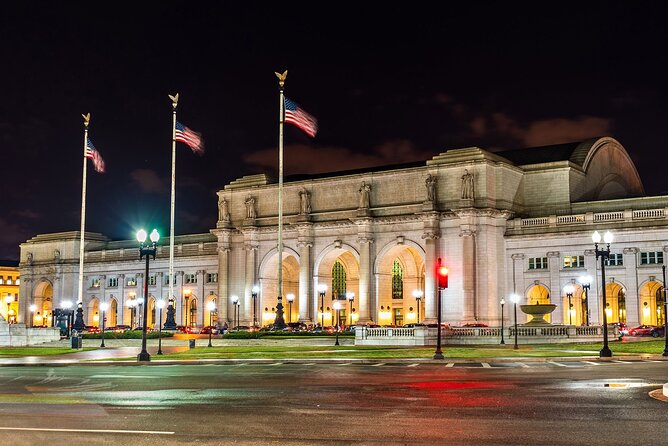
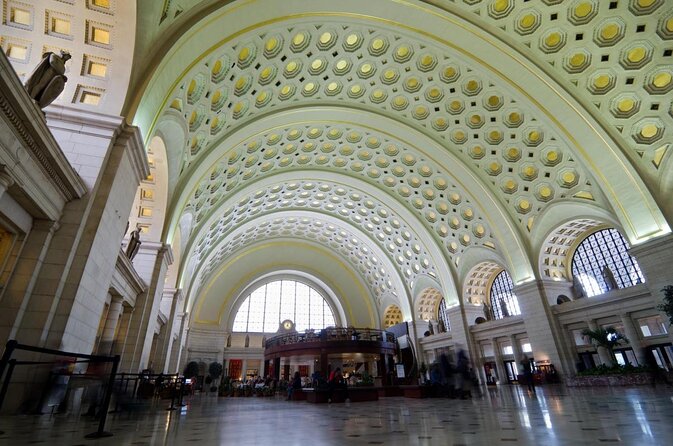
Union Station is the kind of building that makes you stop without trying. It opened on October 27, 1907 and was completed in April 1908, and it was designed by architect Daniel Burnham, one of the big names in American architecture of that era.
This stop is timed at about 30 minutes, and the structure of the experience here matters: you’re given a history behind the station, then you can look around with that story in mind. You’ll also understand how a major rail terminal didn’t just move trains—it helped shape the way people experienced DC and how the city developed beyond the Capitol core.
Practical note: this is a “start strong” point. Union Station is a natural place to orient yourself, especially if it’s your first time in this part of the city. Go in with a little curiosity about architecture and you’ll get more out of the experience than if you’re treating this as a quick photo stop.
Federal courts, Thurgood Marshall, and the Supreme Court route that makes Capitol Hill make sense
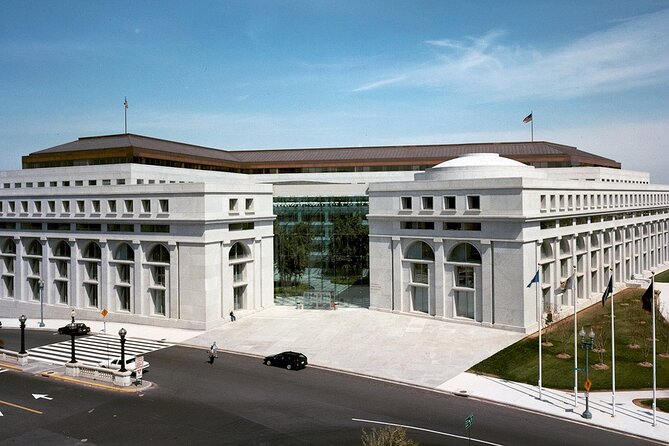
After Union Station, the tour transitions into the legal heart of Capitol Hill. One stop is at the administrative headquarters of the federal judiciary, where the guide focuses on who Thurgood Marshall was and how his work connects to Capitol Hill and America’s history.
Then you’re led to the Supreme Court stop. Here, the experience is aimed at helping you understand both the building and how the court functions today. Even if you’ve read about the Supreme Court before, having a guided explanation while you’re looking at the real space makes it easier to connect the dots between the law, the nation, and the city’s power center.
What I like about pairing Marshall with the Supreme Court is that it gives context before you reach the most famous courtroom-related building. You’re not just staring at “the famous place”—you’re seeing how people and institutions shaped it.
Obama’s former neighborhood cues, plus the Belmont Paul Women’s Equality Monument

One of the more “neighborhood-feeling” segments is the stop focused on the former President Obama’s DC neighborhood. Instead of giving you generic landmarks, the experience points out where he lived and shares stories tied to his time there.
This is the part you’ll enjoy most if you like DC as a lived-in city—where political figures connect to street-level reality, not just headlines. It also helps you build a mental map of what “the neighborhood” means here, since you can usually tell DC is distinct block by block once you know what to look for.
Then the route turns to the Belmont Paul Women’s Equality Monument, maintained by the National Park Service. This stop centers on the National Women’s Party and the suffragists’ struggle for women’s right to vote. You’ll get the story behind the monument and what it represents in the sweep of women’s rights and suffrage history.
Why that works on this tour: it threads activism through the same civic geography as the courts and Capitol. You’re walking a political corridor, but the themes aren’t only male-coded institutions and speeches. You’re also standing in a monument that explains how voting rights were fought for—and that changes how you read the Capitol skyline.




Folger Shakespeare Library and the Florida House: culture stops that break up the monuments
At the Folger Shakespeare Library stop, you’re heading to what’s described as the world’s largest Shakespeare library. The focus is on how it relates to Capitol Hill, plus Shakespeare history and facts you can carry with you while you’re nearby.
This is a smart pacing move. After multiple civic and political stops, it’s refreshing to switch gears to literature. Even if you aren’t a Shakespeare superfan, you’ll likely find that the library’s scale and location make it feel like part of the city’s identity, not an “extra.”
Next comes the Florida House, described as the only state embassy in DC. The tour explains why it exists and how it functions today. If you’re coming from Florida, the stop is positioned to offer extra benefits—so you can expect the content to include angles that feel more personally relevant.
The drawback here is simple: these stops sound fun, but they’re not built as long hangs. If you want a slow, deep museum visit, you’ll treat these as interpretive breaks—places where you leave with a handful of ideas and keep moving.
Time at the Frederick Douglass National Historic Site: the Grant connection you’ll want to spot
The Frederick Douglass National Historic Site stop is shorter—about 15 minutes—but the planned focus is sharp. You’ll learn about Douglass’s former home and his connection with President U.S. Grant, plus more story context.
This one works because it uses a major figure without turning it into a checklist. A short time limit can actually be an advantage when the information is organized around a specific connection—in this case, how Douglass’s story intersects with Grant’s era.
If you’re the type who likes to understand “how people influenced events,” this is a good place to slow your pace for a minute, look around, and let the name recognition turn into actual context.
United States Capitol and the speeches you can picture in stone
The route ends with an especially iconic stop: you’ll see the United States Capitol and get an explanation of its history and architecture. You’ll also be guided toward the famous speeches held there.
This is the segment where the app format can really help you get more out of exterior viewing. The Capitol is so photographed that it’s easy to feel like you’ve “seen it already.” Tying the building to specific speeches and architectural intent gives you a better reason to keep looking instead of just snapping a quick picture.
Keep your expectations realistic: this is described as a walking circuit with guided interpretation, not a guided interior tour. If you want interior access and formal tour timing, you’d need separate plans, because this experience is built around explanations at the locations as you pass.
Library of Congress finale: ticket included, but plan for reservations
The final stop is the Library of Congress, where the experience runs about 45 minutes. You’re told you’ll see why it’s called the world’s largest library and learn about its history and treasures you can find inside.
The value here is twofold. First, the tour includes admission ticket access for this stop. Second, the time block is long enough to turn it into a real ending rather than a “pass-through” at the last minute.
Now, the key practical caution: one piece of feedback highlighted that entry may require a reserved time scheduled before you go. If you assume you can just arrive and walk in like a general attraction, you could end up frustrated. I’d treat the Library of Congress end as your planning checkpoint—confirm what you need ahead of time so your final stop isn’t a scramble.
Also note: the tour ends inside the Library of Congress at 101 Independence Ave SE, Washington, DC 20540. Plan your route so you don’t have to rush to catch transit immediately after you arrive in the building.
Price and value: $5 per group up to 15 can be a bargain
At $5.00 per group (up to 15), this is priced more like a perk than a full-priced tour. For families, friend groups, or small travel parties, that math can be very appealing—especially when you get included admission at two big anchor stops.
The trade-off is that this experience isn’t built like a live guided lecture where you can ask questions in the moment. Instead, you’re relying on the app’s explanations and any virtual guide features tied to the device. If your phone loses connection or the app doesn’t load as expected, you may not get the full benefit of the planned storytelling.
So here’s how I’d frame the value: if you want a low-cost, structured way to walk from Union Station through Capitol Hill landmarks and finish at the Library of Congress, the price is hard to beat. If you need flawless tech reliability or you get annoyed easily by app prompts, you’ll want to think twice.
Who should book this route, and who should skip it
This tour is a strong fit for people who like history told in manageable chunks while walking. You’ll likely enjoy it if you want to see Washington DC’s civic map—Union Station, courts, suffrage monuments, the Capitol, and the Library of Congress—without booking a schedule packed with separate tickets.
It’s also a good match for groups because the price is per group and the activity is private. If you’re traveling with a mix of interest levels, the cultural stop at the Folger and the state embassy stop at Florida House can help keep everyone engaged.
I’d be cautious if you know you’ll be traveling with weak phone connectivity or if you need a smooth, no-fuss entry process into major venues. The Library of Congress end is a major “make or break” point, so your comfort with possible reservation requirements matters.
Should you book the Washington DC Neighborhoods app tour?
If your goal is a 2–4 hour app-guided walking route that connects famous DC buildings to clear story themes, this is a budget-friendly way to do it. The included admission at Union Station and the Library of Congress adds real value, and the stop mix gives you more than postcard sightseeing.
If you hate tech hiccups or you’re sensitive to timed-entry rules at big institutions, I’d only book if you’re ready to handle the practical side: make sure you’re set up to access the virtual/guide content and that your Library of Congress visit plan works before you arrive.
FAQ
How much does the tour cost?
It costs $5.00 per group, up to 15 people.
How long does the tour take?
The duration is about 2 to 4 hours.
What language is the tour offered in?
The tour is offered in English.
Where does the tour start and end?
It starts at Union Station, 50 Massachusetts Ave NE, Washington, DC 20002, and ends inside the Library of Congress, 101 Independence Ave SE, Washington, DC 20540.
What are the main stops on the route?
You’ll visit Union Station, the federal judiciary headquarters area tied to Thurgood Marshall, a stop connected to the former Obama neighborhood, Frederick Douglass National Historic Site, Folger Shakespeare Library, Florida House, the Belmont Paul Women’s Equality Monument, the Supreme Court, the United States Capitol, and then the Library of Congress.
Are admission tickets included?
Yes. Union Station and the Library of Congress are listed with admission ticket included. Frederick Douglass National Historic Site and several other stops are listed as free admission.
Do I need a reservation to enter the Library of Congress?
The information provided indicates that a reservation may be required for entry without issues, so you should be prepared for that before going.
Is this a private tour?
Yes. It’s private, and only your group will participate.
What’s the typical booking timeframe?
On average, it’s booked 5 days in advance.
What’s the cancellation policy?
You can cancel for free up to 24 hours in advance for a full refund.
More Self-Guided Tours in Washington DC






More Tour Reviews in Washington DC






Just Added: Fresh Washington DC Reviews
- Washington : Private Custom Walking Tour With A Guide (Private)★ 3.5 · 3 reviews
- 3-Hour Small Group Memorial Tour in Washington, D.C.★ 4.0 · 3 reviews
- Washington DC Private Guided Bus Day Tour with Step Off Guide★ 5.0 · 3 reviews
- Washington, DC: The Good Liar: Brian Curry★ 5.0 · 3 reviews
- DC Monuments Walking Tour: Small Group, Big Ideas★ 5.0 · 3 reviews
- Washington DC: Library of Congress Private Tour with Tickets★ 5.0 · 3 reviews
Self-Guided Tours, side by side.
 ★ 4.5Best of DC: Hop-on Hop-off, Night Tour, and Arlington Audio GuideFrom $7564 reviews
 ★ 4.5Washington DC Monuments Self-Guided Walking Audio TourFrom $1615 reviews
 ★ 3.5Washington DC Monuments self-guided walking tour & scavenger huntFrom $446 reviews
 ★ 3.0National Mall Expedition: Personalized Self-Guided App TourFrom $55 reviews
 ★ 4.0Washington DC Museums self-guided walking tour & scavenger huntFrom $444 reviews
 ★ 5.0Customizable Private Self-Guided Tour of Washington DCFrom $4203 reviews
The lists this tour appears in