

Review · NATIONAL MALL & MONUMENTS
Washington DC Monuments Self-Guided Walking Audio Tour
Washington DC reads best on foot. This self-guided audio walk stitches together the White House, the National Mall classics, and the Supreme Court with stories that trigger as you move, plus lifetime access so you can replay it on future trips. The route is built for your pace, so you can pause for photos without feeling rushed.
What I like most is how practical it feels once you’re walking: hands-free narration plays based on location, and the route covers the big-ticket sights in one continuous loop from New York Ave to the Supreme Court area. The one real consideration is setup. You’ll need to download the tour in strong Wi‑Fi or cellular, then log in with a password you receive by email and text (not by scanning a QR code).
In This Review
- Key things to know before you go
- How the audio tour actually guides you through DC
- Price and value: is $16.99 worth it?
- Route overview: from New York Ave to the Supreme Court zone
- Stop-by-stop: what you’ll see and learn along the way
- Stop 1: Woodward Building Apartments
- Stop 2: Albert Gallatin Statue (Fraser)
- Stop 3: The White House
- Stop 4: Eisenhower Executive Office Building
- Stop 5: Constitution Gardens
- Stop 6: World War II Memorial (including hidden details)
- Stop 7: The National Mall
- Stop 8: Lincoln Memorial
- Stop 9: Korean War Veterans Memorial
- Stop 10: U.S. House of Representatives
- Stop 11: Washington Monument
- Stop 12: National Gallery of Art (Sculpture Garden)
- Stop 13: Supreme Court of the United States
- Stop 14: United States Capitol
- Planning tips that make the tour smoother
- Download first, then walk
- Bring headphones
- Expect the route to run longer than the estimate
- If government buildings are closed, you still get context
- Who this tour is best for
- Should you book the Washington DC Monuments self-guided audio tour?
Key things to know before you go
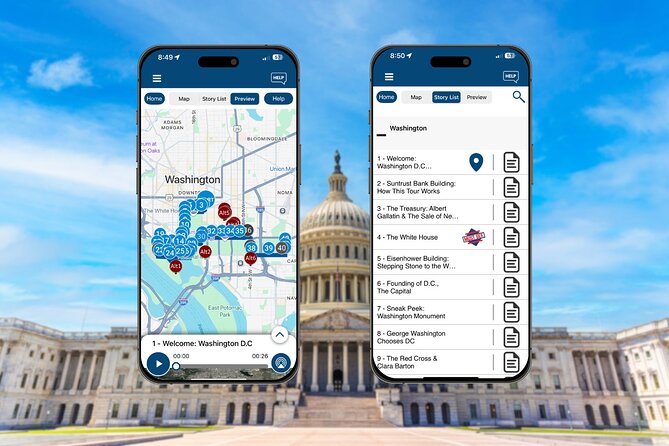
- Location-triggered audio so you don’t have to press play at every stop
- Offline maps meaning you can keep moving even without cellular signal after download
- Lifetime, no-expiry access so the $16.99 keeps paying off on later visits
- 45+ audio stories along a route that’s about 2+ miles long (expect more if you linger)
- A single continuous walk that hits major DC landmarks in about 1–2 hours on paper
- No entry tickets included, so you’re touring from the sidewalk and gardens
More of the Mall, monument by monument
- DC Memorials Night Tour: Glass-Roof Convertible Upgrade Option
★ 4.5 · 6,933 reviews - National Mall Monuments Night Tour with 10+ Stops, Entry Tickets
★ 4.5 · 4,863 reviews - Washington DC Monuments by Moonlight Tour by Trolley
★ 4.5 · 3,956 reviews - DC Monuments and Capitol Hill Tour by Electric Cart
★ 5.0 · 2,841 reviews
How the audio tour actually guides you through DC
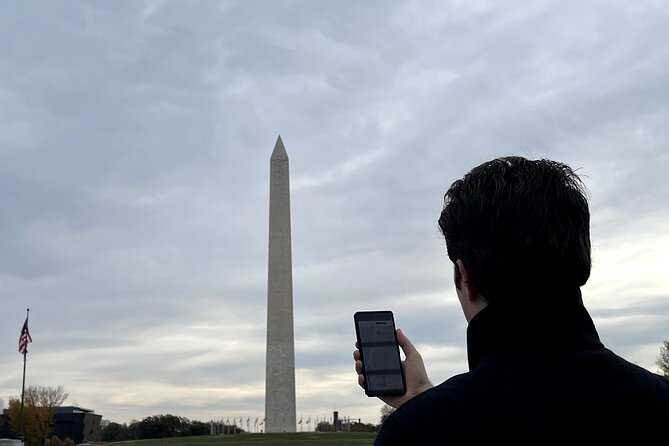
This tour is designed to feel like a calm walk with a companion in your ear. After you download the app and enter your password, you open the audio tour at the start point and let the stories run automatically.
The audio is location-based. As you reach each story point, the next segment starts without you tapping through menus. That matters on the National Mall, where you’ll spend more time looking up at monuments than at your phone. It’s also why headphones are a big deal: you’ll want the sound clear while you’re walking.
Another practical win is offline navigation. The tour includes offline maps, so once you’ve done the initial download, you’re not stuck if your signal drops. Still, there’s a catch: the instructions say you must download while you’re on strong Wi‑Fi or cellular, so plan to do that before you start walking.
You also have full control over timing. You can pause anywhere, take a break, and start again when you’re ready. That flexibility is ideal in DC, where lines, weather, and closures can change what you want to do day to day.
Finally, it’s self-guided and private to your group. No meeting your own guide in person, no waiting for others, just your group following the route at your speed.
Price and value: is $16.99 worth it?
At $16.99 per person for a 1–2 hour walking audio tour, the value depends on what you like to get from a trip: if you enjoy history, context, and learning while you walk, this pricing makes sense.
Here’s why I think it’s a good deal:
- You’re paying for time-saving storytelling. Instead of piecing together facts from random sources while you stand in front of big monuments, you get guided narration built around the route.
- You’re not buying tickets. The tour explicitly doesn’t include admission passes or entry reservations. That’s not a flaw if you’re happy to view many landmarks from the outside, gardens, and surrounding areas.
- Lifetime access is the hidden value. The tour is described as lifetime access with no expiry. If you ever return to DC, you can reuse the download and skip the planning stress.
- It can stretch into a longer afternoon. One review noted about 3.5 hours with breaks at memorials. If that sounds like your style, the cost per minute gets even smaller.
If you prefer a guide you can ask questions to, you’ll likely want a live tour too. But for independent travelers who want structure without a strict schedule, this is priced like a smart add-on.
Route overview: from New York Ave to the Supreme Court zone

The start point is 1425 New York Ave NW, Washington, DC 20005, and the route ends at the Supreme Court of the United States, 1 First St NE, Washington, DC 20543 (with the itinerary also listing the U.S. Capitol as the next stop). In real-world terms, you’re walking the central DC government and memorial corridor—easy to understand because the sights are iconic and close together compared with the city’s overall scale.
The tour note says it’s over 2+ miles long and includes 45+ audio stories, with an estimated completion time of about 1–2 hours. That estimate assumes you keep moving through each story point around the stated pacing. If you stop for photos, read plaques, or pause at viewpoints, expect more time.
Practical pacing tip: on a day when you want to see lots of museums too, this audio walk helps you get the city’s spine first. Once you’ve done this, you’ll know where everything is relative to the Mall and major government buildings.
Also, DC weather matters. The experience notes say it requires good weather. If you’re going in hot sun or heavy rain, you’ll want a backup plan and water/hat.
Stop-by-stop: what you’ll see and learn along the way

This tour strings together 14 stops in a logical flow. Most story points are designed for quick listening (about 5 minutes each), but you can linger before moving on to the next location trigger.
DC at walking pace, more routes




Stop 1: Woodward Building Apartments
Your walk starts near The Woodward Building Apartments, described as a community unlike any other in the area. This is a useful opener because it gives you a sense of DC beyond the postcard monuments. It’s also a low-pressure first audio block if you need a moment to get your phone working and your headphones comfortable.
Tip: start here with a clear plan for your first 10 minutes. If you’re still testing audio levels, set that up now so later you can focus on the monuments.
Stop 2: Albert Gallatin Statue (Fraser)
Next is the Albert Gallatin statue, a bronze work by James Earle Fraser. It commemorates Albert Gallatin, who founded New York University and served as U.S. Secretary of the Treasury. This is a reminder that DC history includes people who shaped education and finance, not just presidents and memorials.
Why it’s worth a stop: Fraser’s public sculptures are a style of storytelling in themselves, and the audio gives you a reason to look closely at the statue instead of walking past.
Stop 3: The White House
Your first major landmark is the White House. The narration focuses on what you see and also shares construction-related history. Even if you know the big picture, hearing the specifics while standing in front of it helps the whole area feel less generic.
Practical drawback: you’re viewing from the outside. If you want interior access, you’ll need separate tickets or a different kind of tour.
Stop 4: Eisenhower Executive Office Building
Then you pass the Eisenhower Executive Office Building, formerly the Old Executive Office Building and even earlier known as the State, War, and Navy Building. This stop is a good checkpoint for understanding how Washington’s government buildings evolved and shifted roles over time.
Look around: the building’s setting near the White House area makes it easy to orient yourself quickly for the rest of the walk.
Stop 5: Constitution Gardens
You continue through Constitution Gardens, one of DC’s green spaces. This is a breathing moment. You trade monumental stone for landscaping and open sightlines, which makes the next memorial stretch feel easier.
If you’re walking with kids or anyone who gets tired, this garden section is a smart place for a slow pause and a quick snack break.
Stop 6: World War II Memorial (including hidden details)
Next comes the World War II Memorial. The audio invites you to pay respects and also points you toward two hidden Kilroy was here engravings. That kind of detail is exactly why this type of audio tour works: it turns a stop into an activity, not just a photo.
Time tip: if you want to find the Kilroy engravings at a relaxed pace, don’t rush this segment.
Stop 7: The National Mall
Now you reach the National Mall—the long greenway that hosts many of the city’s most famous sights. The narration acts like a connector, helping you understand where you are in the larger “DC on a grid” layout.
What you’ll love here: the Mall is where you can get your bearings fast. After this, every other landmark feels like it has a place.
Stop 8: Lincoln Memorial
Up next is the Lincoln Memorial. Expect a focus on Lincoln’s presence and the memorial’s powerful setting, including what you’ll see in front of the pavilion and nearby inscriptions.
Photo reality check: this is one of the most photographed places in DC. Even though the tour aims to help you beat crowds by walking, you may still share space. Your audio pacing lets you move on when you’re ready.
Stop 9: Korean War Veterans Memorial
Then you arrive at the Korean War Veterans Memorial, noted for thousands of photographs and surprising architecture, along with symbolism explained in the audio. If you like memorials that communicate through design rather than only plaques, this stop tends to land well.
Time tip: this is another place where a 5-minute story can become 15 minutes once you start noticing layout and details.
Stop 10: U.S. House of Representatives
Next is the United States House of Representatives area, described as the place where legislation is created and debated. The audio frames the building not as a generic symbol, but as the working engine of government.
Good to know: like most DC government buildings, access varies. Plan for viewing from outside and let the audio explain what’s happening behind the scenes.
Stop 11: Washington Monument
The walk brings you to the Washington Monument, described as an iconic white obelisk once the world’s tallest structure, later dethroned by the Eiffel Tower. This is a classic “look up” moment, and the history gives the skyward shape extra meaning.
If you’re short on time later, this is still worth a stop because the audio turns a simple viewpoint into a story.
Stop 12: National Gallery of Art (Sculpture Garden)
Then you stroll into the National Gallery of Art area, specifically the Sculpture Garden, described as a cozy park with strange, captivating works of art.
Why this works in an audio walk: it adds texture and variety. After the stone-and-state buildings, art lets you slow down without feeling like you’re taking a detour.
Stop 13: Supreme Court of the United States
Finally, you reach the Supreme Court of the United States. The audio focuses on Constitutional Law and the court’s role, described in plain, memorable terms.
Important planning note: one itinerary label says the tour concludes here, and your listed end point is the Supreme Court address. If you see the U.S. Capitol listed as a further stop in your app, treat it as a bonus rather than a guarantee of exact timing.
Stop 14: United States Capitol
The last stop on the route list is the United States Capitol Building, the domed structure many people recognize instantly. The audio gives background on how this branch of government came into being.
If your legs are feeling good, this is a satisfying finish. If you’re tired, the audio gives you enough context to enjoy the exterior view even when you keep moving.
Planning tips that make the tour smoother

Download first, then walk
The app requires download while you’re in strong Wi‑Fi or cellular. Do that before you start at the meeting point. This is the single biggest thing that can make or break the experience.
Bring headphones
The best experience note says to bring headphones or earbuds. Even if you can hear outside noise, better sound clarity means you catch story details, like who built what, and what symbolism refers to.
Expect the route to run longer than the estimate
The stated pacing is about 5 minutes per story point and 1–2 hours overall. That’s the “keep moving” scenario. Real walking days often stretch. One review mentioned about 3.5 hours with extra time at memorials, and you’ll also want breaks for photos.
If government buildings are closed, you still get context
One review noted that when some sites were closed due to a shutdown situation, the tour still helped because you get the information as you pass by. That’s the upside of an exterior walking audio format: you don’t lose the story if you can’t enter.
Who this tour is best for

This audio walk is a great fit if you:
- Want to hit major monuments and government landmarks in one organized route
- Prefer pacing yourself over joining a group bus tour
- Like learning facts you can hold onto while standing at real places
- Appreciate offline access and a tour you can replay later
It’s less ideal if you:
- Expect lots of indoor entry tickets included (none are included here)
- Need a live guide to answer questions on the spot
- Struggle with phone navigation without help (you’ll want GPS on a recommended device)
Should you book the Washington DC Monuments self-guided audio tour?

I’d book this if you want an efficient, low-stress way to understand DC’s “big icons” without committing to a rigid group schedule. The lifetime access and offline capability make it especially good value for repeat trips, and the route covers an impressive spread of sites from the White House area through the Mall to the Supreme Court zone.
Before you buy, do two quick checks:
- Are you comfortable downloading the tour first on good connectivity and using a password from email/text?
- Do you want an exterior walking experience where the audio supplies most of the context?
If yes, this is an easy add-on that can turn a simple walk into a memorable, well-paced DC day.
DC on Foot: More Walks






More Tour Reviews in Washington DC






The Mall, Monument by Monument


Just Added: Fresh Washington DC Reviews
- Washington : Private Custom Walking Tour With A Guide (Private)★ 3.5 · 3 reviews
- 3-Hour Small Group Memorial Tour in Washington, D.C.★ 4.0 · 3 reviews
- Washington DC Private Guided Bus Day Tour with Step Off Guide★ 5.0 · 3 reviews
- Washington, DC: The Good Liar: Brian Curry★ 5.0 · 3 reviews
- DC Monuments Walking Tour: Small Group, Big Ideas★ 5.0 · 3 reviews
- Washington DC: Library of Congress Private Tour with Tickets★ 5.0 · 3 reviews
National Mall & Monuments, side by side.
 ★ 4.5DC Memorials Night Tour: Glass-Roof Convertible Upgrade OptionFrom $696,933 reviews
 ★ 4.5National Mall Monuments Night Tour with 10+ Stops, Entry TicketsFrom $654,863 reviews
 ★ 4.5Washington DC Monuments by Moonlight Tour by TrolleyFrom $483,956 reviews
 ★ 5.0DC Monuments and Capitol Hill Tour by Electric CartFrom $552,841 reviews
 ★ 4.5National Mall Night Tour with 10+ Monuments (Public or Private)From $682,207 reviews
 ★ 5.0Small Group National Mall Night Tour with 10 Top AttractionsFrom $991,658 reviews
 ★ 4.6Monuments by Moonlight Nighttime Trolley TourFrom $481,529 reviews
 ★ 4.8National Mall Tour by Electric VehicleFrom $531,252 reviews
The lists this tour appears in