
DC’s monuments feel endless. This tour keeps them moving.
I love how this guided scooter tour strings together the National Mall’s biggest sights in about 2.5 hours, with narration that makes the stops click instead of blur. You get a fast, efficient route that means less walking and less waiting, so you spend more time looking at marble, bronze, and the stories behind them.
My favorite part is the way the guide supports new riders too. If it’s your first time on a scooter, I like that there’s a real safety and comfort focus before you start, and the group stays small (maximum 16). One thing to consider: it’s still a scooter tour, so you’ll want moderate physical fitness and comfort spending a couple hours on your feet and on the ride, especially in warm or chilly weather.
In This Review
- Key things you’ll notice right away
- Meeting at 1012 14th St NW: what this 2.5-hour ride really feels like
- Getting comfortable on a scooter: the safety talk that makes new riders stick with it
- Lafayette Square to the White House: the fast route to a big wow
- Sherman Monument stop: a short moment with real context
- The Smithsonian edge: African American History, the Castle, and the Mall’s cultural core
- Washington Monument: the stop that works even without tickets
- From the Tidal Basin to Jefferson: cherry blossom territory with major quotes
- Seeing the Pentagon across the water: a quick reminder of modern power
- Martin Luther King Jr. Memorial Bookstore and the civil rights thread
- World War I Memorial: a story shown in motion and loss
- Korean War Veterans Memorial: short time, heavy meaning
- Lincoln Memorial: classic scale and a line you’ll remember
- Vietnam Veterans Memorial: where names and granite take over
- World War II Memorial: stone architecture and bronze sculpture
- Value check: why $137 can make sense on the National Mall
- What to bring: the small details that affect comfort
- Should you book this National Mall scooter tour?
- FAQ
- How long is the Public Group Scooter Tour of DC’s National Mall?
- Where does the tour start?
- How much does it cost?
- What’s the group size limit?
- What age is the minimum for this tour?
- Are pets allowed?
- What if the weather is poor?
Key things you’ll notice right away
- Small group size (max 16): easier pacing and less crowd pressure at busy memorials.
- Safety and comfort focus from Barry: helpful check-in before you roll.
- 2.5-hour loop with major memorials: you hit the highlights without the day-long trek.
- Free access at the stops: the tour adds narration and transport, not entry fees.
- Mobile ticket: less fuss when you meet up.
- Small pets allowed with a proper backpack: a useful option if you travel with a little companion.
More of the Mall, monument by monument
- DC Memorials Night Tour: Glass-Roof Convertible Upgrade Option
★ 4.5 · 6,933 reviews - National Mall Monuments Night Tour with 10+ Stops, Entry Tickets
★ 4.5 · 4,863 reviews - Washington DC Monuments by Moonlight Tour by Trolley
★ 4.5 · 3,956 reviews - DC Monuments and Capitol Hill Tour by Electric Cart
★ 5.0 · 2,841 reviews
Meeting at 1012 14th St NW: what this 2.5-hour ride really feels like
The tour starts at 1012 14th St NW and ends right back at the meeting point. The timing is about 2 hours 30 minutes, which is long enough to cover a lot of the Mall, but short enough that you don’t feel like you’re stuck on a schedule all day.
That duration matters, because the National Mall can chew up time fast. Even if you only want the famous sites, walking distances add up, and waiting for photo turns can quietly stretch your day. Here, the scooter keeps you in motion while your guide handles the pacing and the narration.
You’ll also like the group structure. With a maximum of 16 travelers, you generally won’t feel lost in a big, slow-moving pack. The goal is a smooth loop with frequent stops for photos and context.
Getting comfortable on a scooter: the safety talk that makes new riders stick with it
Scooter tours are only fun when you feel steady. The best sign is the human part: the guide makes sure everyone is comfortable and safe before you head out. One review specifically called out Barry taking time with first-time riders and making sure the group felt prepared.
Here’s what that means for you in plain terms: don’t rush the practice. If you’re new, treat the setup moment as part of the experience. Ask questions early. Get your starting rhythm down before the group rolls out. When the ride is calm, the stops are more enjoyable because your attention goes where it should—onto the buildings and memorials.
Also keep in mind that this is a scooter experience with an outdoors route. Wear shoes you can walk in, and dress for the day’s weather. The tour also requires good weather, so plan to have a backup date in mind.
Lafayette Square to the White House: the fast route to a big wow
Your first major sight is the White House, viewed from Lafayette Square on the north side. The point here isn’t just a quick glance. Lafayette Square gives you a classic viewpoint with open sightlines and a strong sense of place, plus you’re looking toward the North side with parklands and trees beyond.
What you’ll appreciate is how the scooter gets you there without turning your morning into a grind. The White House grounds and surrounding gardens are part of the impression—the grand columns and white facade are obvious, but it’s the setting that makes the view feel important rather than just photo-op.
Practical note: this is one of the most photographed areas in the city, so you’ll want to be patient and let the guide manage photo flow.
Sherman Monument stop: a short moment with real context
Next up is the William Tecumseh Sherman Monument, a bronze statue designed by Augustus Saint-Gaudens and dedicated in 1903. The stop is brief—about 5 minutes—so treat it like a punctuation mark in the story of US history rather than a deep study.
If you like monuments that connect art and national memory, you’ll probably enjoy seeing the craftsmanship up close. Saint-Gaudens is a big name in American sculpture, and this is the kind of memorial that feels more meaningful once you get the basic background.
The city on two wheels, a few more routes



The Smithsonian edge: African American History, the Castle, and the Mall’s cultural core
This stretch shifts from political power to museums and living culture. Your route includes the National Museum of African American History and Culture and the Smithsonian Castle.
Even if you don’t go inside during the scooter tour time, you’re still getting something valuable: orientation. You’ll see how these institutions sit along the Mall axis and understand why this area isn’t just about Presidents and wars—it’s also where the Smithsonian frames national identity through objects, stories, and scholarship.
A quick heads-up: museum exteriors can be visually dense. If you want the best photos, arrive ready to move. Don’t assume you’ll have long to stand still. Your guide’s job is to keep the loop moving while you get the highlights.
Washington Monument: the stop that works even without tickets
Then comes the Washington Monument, built between 1848 and 1884 and designed by Robert Mills. It’s 555 feet 5 1/8 inches tall. That size is hard to appreciate until you’re actually looking at it.
You’ll get about 7 minutes here, which is just enough time to:
- take in the scale,
- get a sense of how it lines up with surrounding memorials,
- and understand why it became the visual spine of the Mall.
The best value of a short stop is that you’re not forced to overstay. You can enjoy it, photograph it, and move on before fatigue sets in.
From the Tidal Basin to Jefferson: cherry blossom territory with major quotes
The Tidal Basin is about 107 acres and around 10 feet deep, and it’s famously associated with the Cherry Blossom Festival in spring. Even if you’re not in blossom season, the basin area still feels like a distinct pocket of the city—less like a straight highway of buildings, more like a scenic stage.
Then you’ll roll into the Thomas Jefferson Memorial, built between 1939 and 1943. It’s neoclassical, and it includes Jefferson quotes meant to capture his ideology and ideas about democracy. This stop gives you a chance to shift from monument shapes to words—and the quotes can help you read the memorial instead of just viewing it.
If you like memorials that explain a point of view, you’ll likely enjoy this one. It’s not only a building; it’s a message.
Seeing the Pentagon across the water: a quick reminder of modern power
At one point, you’ll catch a view of the Pentagon from across the Potomac. The Pentagon is the headquarters of the US Department of Defense, and it has five concentric pentagonal rings. It’s one of those buildings you’ve seen in photos before, but seeing it in context reminds you how the Mall’s historical focus sits next to modern governance.
The stop here is more about recognition than deep exploring, so don’t plan to expect a long photo session. Treat it like a “you are really in Washington, DC” moment.
Martin Luther King Jr. Memorial Bookstore and the civil rights thread
You’ll also pass by the Martin Luther King Jr. Memorial Bookstore, located near the MLK Jr. Memorial area in downtown DC. The memorial honors King’s legacy and the struggle for freedom, equality, and justice.
The value of including King’s area in a single Mall loop is that it breaks the pattern. Not every memorial is about Presidents or wars. This one ties the story of the country to ongoing ideals, and the messaging helps connect DC’s past to its moral questions.
Even if you only have about 10 minutes here, that’s enough time to absorb the theme and move without losing your momentum.
World War I Memorial: a story shown in motion and loss
The National World War I Memorial sits in Pershing Park, and it includes a central design called A Soldier’s Journey. It tells the arc of a soldier who leaves family, faces combat and loss, and returns after medical care.
This is one of the stops where narration really matters. In a short visit, the guide’s explanation helps you connect the physical design to the human experience, so it doesn’t feel like just another statue-and-stele stop.
Your time here is about 7 minutes, and that’s enough if you listen with intent.
Korean War Veterans Memorial: short time, heavy meaning
Next is the Korean War Veterans Memorial. The memorial honors the people who answered the call to defend a country they never knew and people they never met.
The key is tone. This stop can feel quieter, more reflective, and more personal than some of the larger, busier monuments. With about 10 minutes, you can step back, read what’s there, and take photos that don’t just look like icons, but actually communicate the purpose.
Lincoln Memorial: classic scale and a line you’ll remember
The Lincoln Memorial is next, with about 10 minutes allotted. Under the structure, you’ll see Lincoln in marble, framed by words about memory and unity.
This is a stop where your guide’s narration can make or break your visit. Lincoln is one of the most famous figures in the world, so it’s easy to rush. Don’t. Spend your time on the details that turn a famous image into a specific message.
Vietnam Veterans Memorial: where names and granite take over
If you’ve seen photos of the Vietnam Veterans Memorial, you already know it hits. The memorial’s two black granite walls list the names of more than 58,000 Americans who died or remain missing, and there’s also a bronze statue of three soldiers and a flagpole.
You’ll also see the Three Servicemen Statue, representing different branches of the US military. This is a shorter stop (about 3 minutes), then the longer emotional anchor comes with the Vietnam memorial at 7 minutes.
For this portion, plan to slow down in your head, even if the scooter is moving you along. It’s one of the few places where the names are the whole point. Your best souvenir isn’t a photo—it’s the moment you take to read even a small section.
World War II Memorial: stone architecture and bronze sculpture
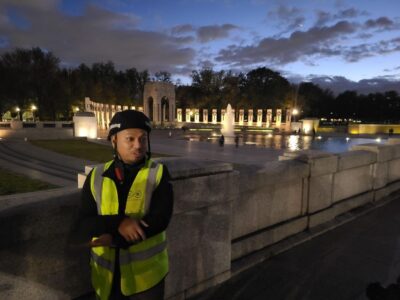
Finally, your route reaches the World War II Memorial. It uses stone architecture and bronze sculptures to recognize service, honor those who fell, and recognize victory tied to restoring freedom and ending tyranny around the globe.
It’s about 10 minutes. The meaning can be felt through the arrangement and the forms, and your guide’s narration helps keep the symbols from feeling like random decor.
If you’re touring the Mall for the major US-history memorial sweep, this is a strong closing note.
Value check: why $137 can make sense on the National Mall
At $137 per group, this tour is not a cheap way to move around Washington. But the value is in what you don’t have to do yourself: you’re buying guided narration plus transportation between major sights in a compact route.
It also helps that the tour’s major stops are free to access, so you’re not paying museum admission or entry fees as you go. Instead, your cost is paying for time saved and context gained.
When I think about value on the Mall, I ask: will I still be energized after hours of walking? If the answer is no, this scooter format can be a smart trade—money for comfort and flow.
What to bring: the small details that affect comfort
A few practical things will make the ride smoother:
- Backpack: the tour allows small pets to accompany you if you use a proper backpack.
- Comfortable shoes: even with scooters, you’ll be stopping and positioning.
- A weather-ready layer: the tour needs good weather, but conditions can still shift across two and a half hours.
- Phone for quick photos, not long screens: you’ll want to keep the group rhythm.
Also, this is for ages 7 and above, and service animals are allowed. If you’re traveling with kids or anyone who needs a slower pace, it’s smart to ask in advance how the guide keeps everyone comfortable.
Should you book this National Mall scooter tour?
If your goal is the best monument and memorial overview without spending the day walking and waiting, I think this tour fits. The mix of big-name sites and clear narration is built for time-strapped visitors, and the guide’s focus on safety for new riders is a real plus.
I’d skip it (or at least think twice) if you’re looking for a slow, sit-and-read museum style day. This is a ride-and-stop format. You’ll get meaning, but you won’t get hours at a single memorial.
FAQ
How long is the Public Group Scooter Tour of DC’s National Mall?
It’s approximately 2 hours 30 minutes.
Where does the tour start?
The meeting point is 1012 14th St NW, Washington, DC 20005, USA, and the tour ends back at the meeting point.
How much does it cost?
The price is $137.00 per group.
What’s the group size limit?
This activity has a maximum of 16 travelers.
What age is the minimum for this tour?
The tour only allows travelers 7 years old and above.
Are pets allowed?
Small pets are allowed if you bring a proper backpack.
What if the weather is poor?
The experience requires good weather. If it’s canceled due to poor weather, you’ll be offered a different date or a full refund.
More Tour Reviews in Washington DC






The Capital on Two Wheels






The Mall, Monument by Monument


Just Added: Fresh Washington DC Reviews
- Washington : Private Custom Walking Tour With A Guide (Private)★ 3.5 · 3 reviews
- 3-Hour Small Group Memorial Tour in Washington, D.C.★ 4.0 · 3 reviews
- Washington DC Private Guided Bus Day Tour with Step Off Guide★ 5.0 · 3 reviews
- Washington, DC: The Good Liar: Brian Curry★ 5.0 · 3 reviews
- DC Monuments Walking Tour: Small Group, Big Ideas★ 5.0 · 3 reviews
- Washington DC: Library of Congress Private Tour with Tickets★ 5.0 · 3 reviews
National Mall & Monuments, side by side.
 ★ 4.5DC Memorials Night Tour: Glass-Roof Convertible Upgrade OptionFrom $696,933 reviews
 ★ 4.5National Mall Monuments Night Tour with 10+ Stops, Entry TicketsFrom $654,863 reviews
 ★ 4.5Washington DC Monuments by Moonlight Tour by TrolleyFrom $483,956 reviews
 ★ 5.0DC Monuments and Capitol Hill Tour by Electric CartFrom $552,841 reviews
 ★ 4.5National Mall Night Tour with 10+ Monuments (Public or Private)From $682,207 reviews
 ★ 5.0Small Group National Mall Night Tour with 10 Top AttractionsFrom $991,658 reviews
 ★ 4.6Monuments by Moonlight Nighttime Trolley TourFrom $481,529 reviews
 ★ 4.8National Mall Tour by Electric VehicleFrom $531,252 reviews
The lists this tour appears in